Explore Metalworking Machines: A Guide to Types, Basics, and Industrial Applications
Metalworking machines are industrial machines used to shape, cut, drill, bend, grind, and finish metal materials into specific components and products. They play an important role in modern manufacturing because metal parts are required in automobiles, aircraft, construction equipment, electrical systems, medical instruments, industrial machinery, and many other applications.
Introduction to Metalworking Machines
Metalworking technology has developed from manually operated equipment to advanced computer-controlled systems. Today, CNC metalworking machines use programmed instructions to control machining operations with consistent movements and dimensions. These machines help manufacturers produce complex components while maintaining repeatable manufacturing processes.
Industrial metalworking machines are available in different configurations depending on the material, component dimensions, required accuracy, and production volume. Some machines remove material through cutting or grinding, while others change the shape of metal through pressing, bending, or forming.
Understanding metal working machines helps manufacturers, engineers, technicians, and students identify suitable equipment for different industrial applications.
Basic Working Principles
Most metalworking operations involve one or more of the following processes:
Cutting: Removing unwanted material to achieve a required shape or dimension.
Turning: Rotating a metal workpiece against a cutting tool to create cylindrical components.
Milling: Using rotating cutting tools to produce slots, surfaces, grooves, and complex shapes.
Drilling: Creating holes in metal components using specialized cutting tools.
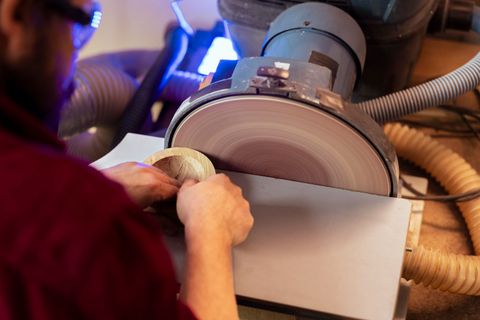
Grinding: Removing small amounts of material to improve surface finish and dimensional accuracy.
Bending and forming: Applying mechanical force to change the shape of sheet metal or other metal sections.
Finishing: Improving surface quality through polishing, deburring, or other finishing processes.
CNC machine tools automate many of these operations through digital programs that control tool movement, spindle speed, feed rates, and machining sequences.
Importance of Metalworking Machines in Modern Industry
Metalworking equipment supports industrial production by converting raw metal materials into functional components. Its importance has increased as manufacturing industries require consistent dimensions, complex designs, shorter production cycles, and improved material utilization.
Industries That Depend on Metalworking Equipment
Automotive manufacturing: Producing engine components, transmission parts, brake components, shafts, and chassis elements.
Aerospace: Manufacturing precision structural components, turbine parts, and specialized metal assemblies.
Construction: Producing steel structures, metal frames, fasteners, pipes, and construction equipment components.
Electrical manufacturing: Creating enclosures, connectors, electrical panels, and machine components.
Medical equipment: Manufacturing selected surgical instruments, metal housings, and precision components.
Heavy engineering: Producing industrial equipment, hydraulic components, gears, and machine structures.
Energy: Manufacturing turbine components, industrial fittings, and equipment used in power generation.
Benefits of Industrial Metalworking Machines
Modern precision metalworking equipment supports several manufacturing requirements:
Consistent dimensions across repeated production batches.
Accurate machining of complex component geometries.
Improved control over cutting and forming operations.
Reduced dependence on repetitive manual operations.
Better integration with automated manufacturing machines.
Improved production planning through digital programs and monitoring.
More organized inspection and quality-control procedures.
The actual results depend on machine condition, tooling, material properties, programming accuracy, operator skills, and maintenance practices.
Main Types of Metalworking Machines
| Machine type | Main operation | Common applications |
|---|---|---|
| CNC lathe | Turning | Shafts, bushings, and cylindrical parts |
| CNC milling machine | Milling | Slots, surfaces, and complex components |
| Drilling machine | Hole making | Metal plates and machine assemblies |
| Grinding machine | Surface finishing | Precision surfaces and tool finishing |
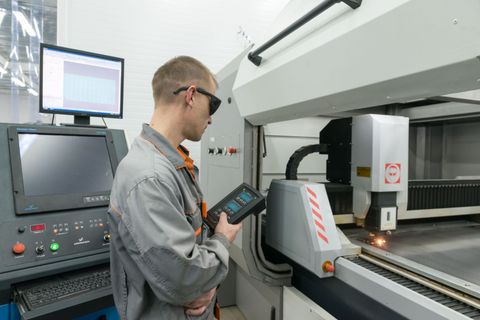
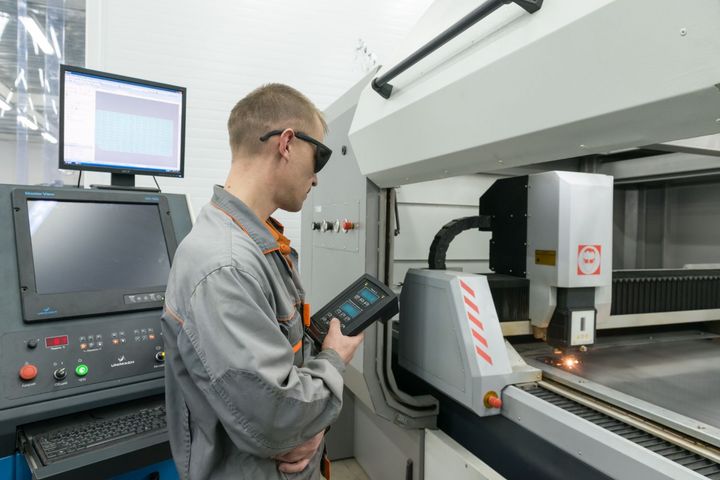
| Laser cutting machine | Laser-based cutting | Sheet metal and industrial panels |
| Plasma cutting machine | Plasma arc cutting | Metal plates and structural parts |
| Hydraulic press | Metal forming | Bending, pressing, and shaping |
| Sheet metal bending machine | Bending | Enclosures, panels, and frames |
| CNC machining center | Multiple machining operations | Complex industrial components |
| 5-axis CNC machine | Multi-directional machining | Aerospace and precision engineering |
Understanding CNC and 5-Axis Machining
Computer Numerical Control (CNC) technology uses digital instructions to control machine movements. A CNC system coordinates the cutting tool, workpiece, spindle, and other machine components according to a programmed sequence.
A conventional three-axis CNC milling machine generally moves along the X, Y, and Z axes. A 5-axis CNC machining machine adds two rotational axes, allowing the cutting tool or workpiece to approach components from different directions.
This capability is useful for producing complex surfaces, curved geometries, turbine components, and specialized aerospace parts.
However, five-axis machining requires suitable programming software, machine calibration, workholding arrangements, and operator knowledge.
CNC Machine Tools and Production Accuracy
CNC machine tools include lathes, milling machines, machining centers, drilling systems, and specialized cutting equipment. Their performance depends on factors such as:
Spindle accuracy and rigidity.
Tool selection and tool condition.
Machine calibration.
Workpiece material and hardness.
Cutting speed and feed rate.
Temperature control and vibration management.
Industrial CNC machines may also incorporate automatic tool changers, robotic loading systems, measurement probes, and production-monitoring technology.
Recent Updates and Trends in Metalworking Technology
During 2025 and 2026, metalworking technology continued to develop through digital manufacturing, advanced CNC systems, robotics, and precision engineering. These developments are influencing how manufacturers plan production, monitor equipment, and manage component quality.
Smart Manufacturing and Industry 4.0
Industrial manufacturers are increasingly integrating digital technology into metalworking operations. Industry 4.0 combines connected machinery, production data, automation, and intelligent monitoring.
Some important developments include:
Industrial IoT (IIoT): Connecting machines to monitoring systems for operational data collection.
Artificial intelligence: Supporting production analysis, defect identification, and predictive maintenance.
Robotic automation: Using robotic arms for material handling, loading, unloading, and repetitive operations.
Digital twins: Creating virtual representations of machines or manufacturing processes for simulation and analysis.
Automated inspection: Using sensors and measurement equipment to examine component dimensions and surface conditions.
These technologies can improve production visibility and help manufacturers identify equipment problems earlier.
Advanced CNC and Multi-Axis Machining
Five-axis machining continues to attract attention in aerospace, automotive, medical equipment, and precision engineering. It allows manufacturers to machine complicated geometries with fewer workpiece repositioning operations in suitable applications.
Hybrid manufacturing is another developing area. Some systems combine conventional CNC machining with additive manufacturing, allowing components to be built up and subsequently machined to specific dimensions.
Industrial Manufacturing Developments in India
India's manufacturing sector is receiving continued attention through capital goods development, precision engineering, and technology modernization.
On 3 February 2026, the Government of India published information about Union Budget 2026–27 initiatives for the capital goods sector. The announcements included proposed Hi-Tech Tool Rooms at two locations and measures supporting advanced manufacturing capabilities. These developments are relevant to the wider machine tools and industrial equipment ecosystem.
Manufacturers are also increasingly evaluating locally developed CNC technology, advanced tooling, and digital production systems.
Laws, Policies, and Industrial Safety Requirements
Metalworking machines operate in industrial environments where mechanical, electrical, and occupational safety requirements are important. Manufacturers and factory operators in India must consider applicable legislation, technical standards, and workplace regulations.
Machinery Safety Standards in India
The Bureau of Indian Standards (BIS) develops Indian Standards covering machinery safety, electrical equipment, and industrial applications.
Important areas include:
Machine guarding and protection against moving components.
Emergency stop mechanisms.
Electrical safety and proper grounding.
Risk assessment and hazard reduction.
Safe installation and machine operation.
Operator instructions and maintenance documentation.
The Machinery and Electrical Equipment Safety (Omnibus Technical Regulation) Order, 2024, underwent amendments during 2025. However, the Ministry of Heavy Industries subsequently listed its withdrawal notification dated 16 January 2026. Therefore, manufacturers should not assume that the earlier proposed September 2026 implementation date remains applicable. They should check current BIS notifications and product-specific Quality Control Orders before determining certification requirements.
Occupational Health and Workplace Regulations
India's four Labour Codes, including the Occupational Safety, Health and Working Conditions Code, 2020, became effective on 21 November 2025, according to the Ministry of Labour and Employment.
These provisions are relevant to industrial workplaces that operate heavy machinery, cutting equipment, presses, and automated production systems.
Important workplace considerations include:
Appropriate personal protective equipment.
Machine safety training and operating instructions.
Workplace hazard identification.
Safe handling of metal materials and cutting tools.
Ventilation and control of industrial dust or fumes.
Appropriate emergency arrangements and workplace inspections.
Applicable state rules, notifications, and transitional provisions should also be reviewed.
Tools and Resources for Metalworking Equipment
Selecting suitable industrial metal cutting machines or fabrication equipment requires technical planning. Engineers and production managers can use several digital and practical resources to understand machine capabilities.
Helpful Technical Tools
CAD software: Applications such as Autodesk Fusion and SOLIDWORKS help create engineering drawings and three-dimensional component designs.
CAM software: Computer-Aided Manufacturing programs convert digital designs into machining instructions.
CNC simulation software: Helps examine tool paths and identify possible machining collisions before production.
Cutting parameter calculators: Assist in estimating spindle speed, feed rate, and machining parameters based on tool diameter and material.
Metrology equipment: Coordinate Measuring Machines (CMMs), micrometers, and digital calipers help examine component dimensions.
Maintenance software: Helps record machine inspections, equipment history, lubrication schedules, and maintenance activities.
Material databases: Provide information about metal hardness, strength, machinability, and thermal properties.
Important Factors When Evaluating Machines
Before selecting metal fabrication equipment, manufacturers should examine the following specifications:
| Evaluation factor | What to examine |
|---|---|
| Material compatibility | Steel, aluminium, stainless steel, and other alloys |
| Machine capacity | Maximum component dimensions and weight |
| Accuracy | Required dimensional tolerances |
| Production volume | Expected output per shift |
| Automation | Tool changers, robotic handling, and controls |
| Software | CAD/CAM compatibility and programming features |
| Maintenance | Inspection intervals and replacement components |
| Safety | Guards, emergency stops, and electrical protection |
Understanding Metalworking Machine Prices
Metalworking machine prices vary according to machine size, CNC capabilities, spindle configuration, automation, accuracy, tooling, and manufacturer specifications.
For example, a basic drilling machine and a five-axis CNC machining center have substantially different technical configurations. A high-speed laser cutting system may also require additional equipment for extraction, cooling, and material handling.
Informational disclaimer: Any estimated machine price or equipment quotation should be treated as indicative rather than a confirmed market rate. Final quotations depend on specifications, taxes, installation requirements, accessories, and location.
Frequently Asked Questions
What are metalworking machines used for?
Metalworking machines are used to cut, shape, drill, bend, grind, and finish metal materials. They support the production of components used in automobiles, aircraft, construction, electrical equipment, and industrial machinery.
What is the difference between CNC and conventional machines?
Conventional machines generally depend more on manual operator control, whereas CNC machines use programmed instructions to control movements and machining operations. CNC systems are particularly useful for repeatable production and complex component geometries.
What is a five-axis CNC machining machine?
A five-axis CNC machine operates along three linear axes and two rotational axes. This arrangement allows machining from multiple directions and is useful for complex components with curved or angled surfaces.
Which industries use industrial CNC machines?
Automotive, aerospace, defence, electronics, construction, medical equipment, energy, and general engineering industries use industrial CNC machines for different machining and fabrication requirements.
How should metalworking machines be maintained?
Maintenance should follow the manufacturer's instructions and include regular cleaning, lubrication, calibration, tool inspection, electrical checks, and examination of machine guards. Operators should also maintain records of machine performance and maintenance activities.
Conclusion
Metalworking machines are essential to modern industrial manufacturing because they transform raw metal materials into accurately shaped components and finished products. Different equipment, including CNC lathes, milling machines, laser cutters, hydraulic presses, and five-axis machining centers, supports different production requirements.
As digital manufacturing, robotics, and precision engineering continue to develop, industrial metalworking machines are becoming increasingly connected and automated. Understanding machine types, operating principles, technical specifications, and safety requirements helps manufacturers make informed decisions about their production processes.
A balanced approach combining suitable equipment, trained operators, quality inspection, regulatory awareness, and preventive maintenance supports consistent and organized industrial manufacturing.